Ninety years. That's roughly how long mathematicians have wrestled with one particular question about the Navier-Stokes equations, the math that describes how fluids move. Ocean currents, air flowing over a wing, water running through the pipes in your building. All of it comes down to these equations, and for almost a century nobody could answer a basic question about them: can the math "blow up"? Can a smooth, well-behaved fluid develop what mathematicians call a singularity, a point where the equations break down, in a finite amount of time?
The question was serious enough that in 2000, the Clay Mathematics Institute named it one of the Millennium Prize Problems. Seven problems, a million dollars each, picked because they were considered the hardest open questions in mathematics. In twenty-five years, only one has ever been solved.
On September 8, 2026, OpenAI announced that a group of roughly 10,000 autonomous AI agents may have knocked off a second one. The agents, running on an internal model that isn't available to the public, found a singularity in the three-dimensional Navier-Stokes equations. Time from launching the first agents to the result: about 88 hours. Ninety years of human effort, and then three and a half days.
What actually came out of the machine
The output is a proof running around 165 pages. And here's a detail that matters more than the page count: the proof was formally checked in Lean, a programming language built specifically to verify mathematical arguments step by step. That's not a chatbot writing something that sounds convincing. A formal verification means a computer walked through every logical step and confirmed each one follows from the last.
Now, the honest caveat, because I'm not in the hype business. The Clay Mathematics Institute has not weighed in yet. Human mathematicians are still reviewing the proof, and that review takes time. Proofs at this level have fallen apart before under scrutiny. If it holds up, it would be only the second Millennium Prize Problem ever resolved. If it doesn't, it's still one of the most interesting failed attempts in the history of the field. Either way, something real happened here.
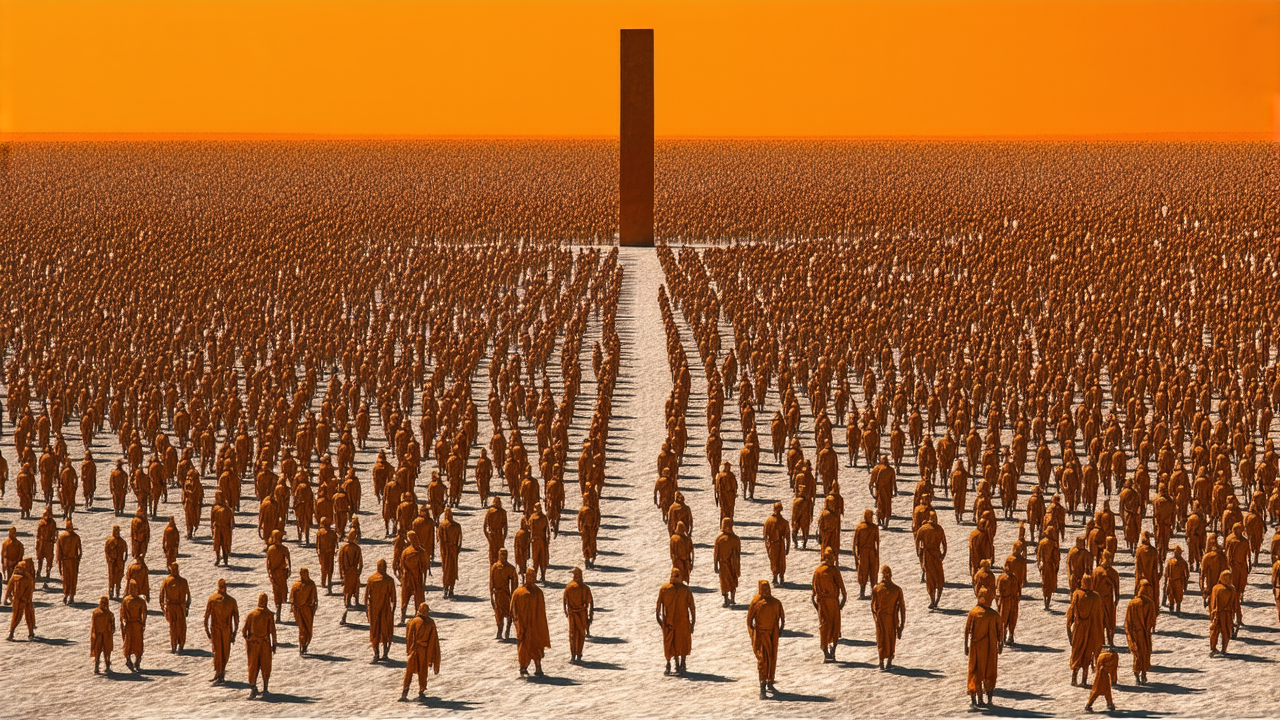
The scale of the effort is worth sitting with. Around 10,000 agents worked in parallel and sent each other close to 5 million messages. The compute bill ran into the millions of dollars. This was not one genius model having a eureka moment. It was a swarm.
The method is the story
And that's the part I keep coming back to. Not the answer. The method.
Think about what those agents actually did. They took an enormous problem, split it into smaller pieces, worked the pieces in parallel, shared what they were learning with each other, threw out the dead ends, and consolidated the best ideas into one final result. No single agent solved anything. The structure solved it.
That pattern is not exotic. It's how good teams already work, when they work well. One person digs into the data, another drafts, another checks the draft against reality, and somebody pulls it all together. The difference is that AI agents can do this around the clock, at whatever scale you can afford, without anyone getting tired or territorial about their piece.
I'm already seeing the small-business version of this show up. Not 10,000 agents and a seven-figure compute bill. More like three or four agents handling a workflow that used to eat someone's afternoon. One agent pulls customer inquiries, another drafts responses, another checks them against your actual policies and pricing, and a person reviews the output before anything goes out the door. Same shape as the math proof. Divide the work, share context, consolidate, verify. We help businesses set up exactly this kind of thing through our AI integration work, and the jump from "one chatbot" to "a few agents that hand work to each other" is bigger than most owners expect.
Where this leaves the rest of us
You don't need to care about fluid dynamics. I don't, honestly, beyond thinking it's a neat story. What you should care about is that the frontier of AI has moved from "one model answers your question" to "many agents work a problem together," and the frontier has a habit of becoming the standard tool a lot faster than anyone plans for.
Nobody's asking you to solve a Millennium Prize Problem. But your business has its own version of a hard, tangled problem. Maybe it's follow-up that falls through the cracks, or reporting that takes two days a month, or quotes that go out slow because three people have to touch them. Those problems break into pieces the same way a math proof does.
So if you're still treating AI as a single chatbot you type questions into, this is a good week to rethink that. The chatbot was the demo. Agents that divide work, share what they learn, and hand you a finished result, that's the tool. It just proved itself on one of the hardest problems humans ever wrote down. Your Tuesday workload will not put up nearly as much of a fight.